×
Request Free Sample ×

Kindly complete the form below to receive a free sample of this Report

* Please use a valid business email

Leading companies partner with us for data-driven Insights

clients tt-cursor
Hero Background

US Mission Critical Communication Market

ID: MRFR/ICT/42558-HCR
200 Pages
Garvit Vyas
February 2026

U.S. Mission Critical Communication Market Research Report: By Component Size Outlook (Hardware, Software, Services), By Hardware (Command and Control Center, Router and Gateways, Distribution Management System, Others), By Services (Consulting Services, Integration Services, Maintenance Services), By Technology Outlook (Land Mobile Radio (LMR), Long-Term Evolution, 5G, Mission-Critical Push-to-X (based on3GPP)), By Land Mobile Radio (LMR) (Analogue, TETRA, TETRAPOL, P25, DMR/dPMR, Others), By Mission-Critical Push-to-X (based on3GPP) (Mission Critical Push-to-Talk (MCPTT), Mission Critical Video (MCVideo), Mission Critical Data (MCData), Push-to-X Messaging, Others), By End-user Outlook (Public Safety and Government Agencies, Transportation, Energy and Utilities, Mining, Others), By Transportation (Railway Operators, Airports, Ports, Others) and By Energy and Utilities (Power Plants, Others) - Forecast to 2035.

Share:
Download PDF ×

We do not share your information with anyone. However, we may send you emails based on your report interest from time to time. You may contact us at any time to opt-out.

US Mission Critical Communication Market Infographic
Purchase Options

US Mission Critical Communication Market Summary

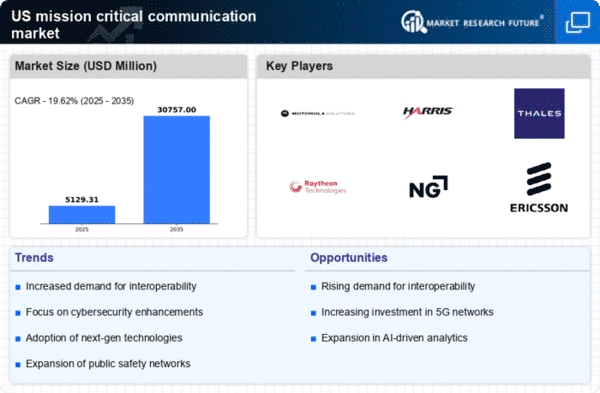
As per Market Research Future analysis, the US mission critical-communication market size was estimated at 4288.0 USD Million in 2024. The US mission critical-communication market is projected to grow from 5129.31 USD Million in 2025 to 30757.0 USD Million by 2035, exhibiting a compound annual growth rate (CAGR) of 19.6% during the forecast period 2025 - 2035

Key Market Trends & Highlights

The US mission critical-communication market is experiencing robust growth driven by technological advancements and increasing public safety demands.

  • The largest segment in the US mission critical-communication market is the public safety sector, which continues to expand due to heightened security concerns.
  • The fastest-growing segment is the broadband communication sector, reflecting a shift towards more efficient and reliable communication technologies.
  • Adoption of broadband technologies and a strong focus on cybersecurity are shaping the current landscape of the market.
  • Technological advancements in communication systems and the growing focus on public safety initiatives are key drivers propelling market growth.

Market Size & Forecast

2024 Market Size 4288.0 (USD Million)
2035 Market Size 30757.0 (USD Million)
CAGR (2025 - 2035) 19.62%

Major Players

Motorola Solutions (US), Harris Corporation (US), Thales Group (FR), Raytheon Technologies (US), Northrop Grumman (US), Ericsson (SE), Nokia (FI), Cisco Systems (US), General Dynamics (US)

Our Impact
Enabled $4.3B Revenue Impact for Fortune 500 and Leading Multinationals
Partnering with 2000+ Global Organizations Each Year
30K+ Citations by Top-Tier Firms in the Industry

US Mission Critical Communication Market Trends

The mission critical-communication market is currently experiencing a transformative phase. This transformation is driven by advancements in technology and the increasing demand for reliable communication systems. As public safety agencies and private enterprises seek to enhance their operational efficiency, the integration of next-generation communication solutions appears to be a priority. This shift is characterized by the adoption of broadband technologies, which facilitate seamless connectivity and interoperability among various communication platforms. Furthermore, the emphasis on cybersecurity measures is becoming more pronounced, as stakeholders recognize the necessity of safeguarding sensitive information against potential threats. In addition, the ongoing evolution of the mission critical-communication market is influenced by regulatory frameworks and funding initiatives aimed at improving infrastructure. Government agencies are actively investing in modernizing communication networks to ensure that first responders and critical services can operate effectively during emergencies. This trend suggests a growing recognition of the importance of robust communication systems in safeguarding public safety and enhancing response capabilities. As the landscape continues to evolve, stakeholders must remain vigilant in adapting to emerging technologies and addressing the challenges that accompany them.

Adoption of Broadband Technologies

The mission critical-communication market is witnessing a notable shift towards the adoption of broadband technologies. This transition enables enhanced data transmission capabilities, allowing for real-time communication and improved situational awareness among first responders. As agencies prioritize interoperability, the integration of broadband solutions is likely to facilitate seamless collaboration across various platforms.

Focus on Cybersecurity

With the increasing reliance on digital communication systems, the mission critical-communication market is emphasizing cybersecurity more than ever. Stakeholders are recognizing the potential vulnerabilities associated with advanced technologies and are investing in robust security measures to protect sensitive information. This trend indicates a proactive approach to safeguarding communication networks against cyber threats.

Regulatory Support and Funding Initiatives

Government initiatives aimed at enhancing communication infrastructure are significantly influencing the mission critical-communication market. Regulatory support and funding programs are being implemented to modernize existing networks, ensuring that public safety agencies have access to reliable communication tools. This trend underscores the commitment to improving emergency response capabilities through strategic investments.

US Mission Critical Communication Market Drivers

Emerging Cybersecurity Threats

As the mission critical-communication market evolves, the threat landscape is also changing, with emerging cybersecurity threats posing significant challenges. The increasing reliance on digital communication systems makes them vulnerable to cyberattacks, which can disrupt critical operations. Organizations are thus compelled to invest in robust cybersecurity measures to protect their communication networks. The market for cybersecurity solutions in this sector is projected to grow by 15% annually, reflecting the urgent need for enhanced security protocols. This focus on cybersecurity not only safeguards sensitive information but also ensures the integrity of communication systems during emergencies, thereby maintaining public trust.

Growing Focus on Public Safety Initiatives

Public safety initiatives are playing a pivotal role in shaping the mission critical-communication market. Governments at various levels are increasingly prioritizing funding for communication infrastructure that supports emergency services. This focus is evident in the allocation of federal and state budgets, with billions of dollars earmarked for upgrading communication systems. For instance, the Federal Communications Commission has proposed initiatives to enhance communication networks for first responders, which could lead to a market expansion of approximately $1 billion by 2026. Such investments are essential for ensuring that emergency personnel have access to reliable communication tools, ultimately improving response times and saving lives.

Regulatory Changes and Compliance Requirements

Regulatory changes are influencing the mission critical-communication market, as agencies must comply with evolving standards and guidelines. These regulations often mandate the adoption of advanced communication technologies to ensure public safety and operational efficiency. For example, the Federal Communications Commission has implemented new rules aimed at improving the reliability of emergency communications. Compliance with these regulations can drive investments in new technologies, with estimates suggesting that the market could see an influx of $500 million in funding for compliance-related upgrades. This regulatory environment encourages innovation and ensures that communication systems meet the necessary standards for effective emergency response.

Increased Demand for Interoperability Solutions

Interoperability among various communication systems is becoming increasingly vital in the mission critical-communication market. As agencies and organizations utilize different technologies, the need for seamless communication across platforms is paramount. This demand is driven by the necessity for coordinated responses during emergencies, where every second counts. The market for interoperability solutions is expected to grow significantly, with estimates suggesting a CAGR of 10% over the next five years. This growth reflects the urgency for systems that can integrate diverse communication tools, thereby enhancing collaboration among first responders and improving overall public safety outcomes.

Technological Advancements in Communication Systems

There is a surge in technological advancements in the mission critical-communication market, particularly in the development of next-generation communication systems. Innovations such as 5G technology and enhanced satellite communications are enabling faster and more reliable data transmission. This is crucial for emergency services and public safety organizations that rely on real-time information. According to recent data, the market for 5G infrastructure is projected to reach $300 billion by 2025, indicating a robust investment in communication technologies. These advancements not only improve operational efficiency but also enhance the overall effectiveness of mission critical communications, ensuring that first responders can communicate seamlessly during emergencies.


Market Segment Insights

By Component: Hardware (Largest) vs. Software (Fastest-Growing)

In the US mission critical-communication market, the distribution of market share among the component segment values is primarily led by hardware. Hardware solutions make up a significant portion of the market, driven by the need for reliable and robust communication systems. In contrast, software, while smaller in market share, is experiencing rapid adoption as organizations seek integrated solutions that enhance functionality and interoperability. The growth trends within this segment are heavily influenced by technological advancements and the increasing demand for seamless communication. The rise of cloud-based software solutions is contributing to the quick expansion of the software segment. Additionally, investments in hardware infrastructure remain strong as agencies upgrade legacy systems to meet modern communication demands. This dual growth indicates a balanced evolution in components, with both hardware stability and software expansion paving the way for future developments.

Hardware (Dominant) vs. Software (Emerging)

Hardware solutions constitute the dominant force in the component segment of the market, characterized by physical devices and infrastructure essential for mission-critical communication. This includes radios, repeaters, and antennas, which ensure reliable connectivity in various operational environments. On the other hand, the software segment, though emerging, is gaining momentum through innovations such as advanced analytics, machine learning, and AI-driven communication platforms. These software solutions enhance the performance and efficiency of hardware, making them integral to holistic communication strategies. As organizations increasingly recognize the importance of integrated solutions, the interplay between established hardware and emerging software will continue to shape the landscape of the US mission critical-communication market.

By Technology: Land Mobile Radio (37% share) vs. 5G (Fastest-Growing)

In the US mission critical-communication market, segment values display varied market share distributions, with Land Mobile Radio (LMR) holding the largest share at 37%. Following LMR, Long-Term Evolution (LTE) and Mission-Critical Push-to-X represent significant portions of the market, while 5G is rapidly gaining traction, indicating a shift towards modern technologies in mission-critical communication. As LMR remains foundational in many sectors, the competitive landscape shows growth potential for other technologies as they cater to evolving communication needs. As demand for real-time data and high-speed connectivity grows, 5G emerges as the fastest-growing segment within the market, driven by advancements in technology and increased investment in infrastructure. The rise of IoT applications and smart city initiatives further accelerate the adoption of 5G, providing robust capabilities that traditional communication methods cannot match. The focus on enhancing communication efficiency and connectivity reliability is creating a dynamic growth environment in the US mission critical-communication market.

Technology: LMR (Dominant) vs. 5G (Emerging)

Land Mobile Radio (LMR) serves as the dominant technology in the US mission critical-communication market, known for its reliability and established presence among public safety and emergency services. LMR systems provide essential voice communication, ensuring seamless connectivity in critical situations. Conversely, 5G represents an emerging technology that promises faster data transmission and low-latency communication, appealing to a broad range of applications beyond traditional voice services. As sectors like transportation, healthcare, and public safety increasingly adopt 5G, it is positioned to enhance operational efficiency, enabling real-time data sharing and advanced analytics. Both technologies cater to specific needs, but together they are poised to transform the landscape of mission-critical communications.

By End-User: Public Safety and Government Agencies (Largest) vs. Transportation (Fastest-Growing)

The US mission critical-communication market exhibits a diverse distribution among its end-user segments. Public Safety and Government Agencies hold the largest market share, benefitting from consistent demand for reliable communication systems to support emergency services and public safety operations. This segment is characterized by significant investments in advanced technologies to enhance coordination and response capabilities. On the other hand, The Transportation segment is the fastest-growing area within the market. This growth is driven by the increasing need for efficient communication solutions in managing traffic operations, logistics, and safety protocols. The push for smart transportation systems and infrastructure development is further propelling the demand for mission critical communication solutions among transportation entities.

Public Safety and Government Agencies: Dominant vs. Transportation: Emerging

Public Safety and Government Agencies represent the dominant segment in the US mission critical-communication market, prioritizing secure and reliable systems essential for emergency response and public safety initiatives. This segment benefits from longstanding governmental investments and regulatory support. In contrast, the Transportation segment is identified as an emerging player, focusing on the integration of advanced communication technologies to streamline operations and enhance safety measures. Transportation stakeholders are increasingly adopting mission critical solutions to address real-time communications needs, driven by the evolving landscape of urban mobility and infrastructure upgrades. Both segments exhibit unique characteristics, catering to distinct operational demands and growth opportunities.

Get more detailed insights about US Mission Critical Communication Market

Key Players and Competitive Insights

The mission critical-communication market is characterized by a dynamic competitive landscape, driven by the increasing demand for reliable communication systems across various sectors, including public safety, defense, and transportation. Key players such as Motorola Solutions (US), Harris Corporation (US), and Raytheon Technologies (US) are at the forefront, each adopting distinct strategies to enhance their market positioning. Motorola Solutions (US) focuses on innovation through the development of advanced software solutions and integrated communication systems, while Harris Corporation (US) emphasizes strategic partnerships to expand its technological capabilities. Raytheon Technologies (US) is leveraging its expertise in defense technologies to enhance mission-critical communication systems, indicating a trend towards specialization in high-stakes environments.The business tactics employed by these companies reflect a concerted effort to optimize operations and enhance service delivery. Localizing manufacturing and optimizing supply chains are prevalent strategies aimed at reducing costs and improving responsiveness to market demands. The market structure appears moderately fragmented, with several key players exerting influence, yet the collective actions of these companies suggest a trend towards consolidation as they seek to enhance their competitive edge.

In October Motorola Solutions (US) announced a strategic partnership with a leading cloud service provider to enhance its communication solutions with AI capabilities. This move is likely to bolster its offerings in data analytics and real-time communication, positioning the company to better serve emergency services and public safety agencies. The integration of AI into their systems may significantly improve operational efficiency and decision-making processes in critical situations.

In September Harris Corporation (US) unveiled a new suite of secure communication tools designed specifically for first responders. This launch underscores the company's commitment to innovation and its focus on addressing the unique challenges faced by emergency personnel. By prioritizing security and reliability, Harris Corporation (US) aims to solidify its reputation as a trusted provider in the mission critical-communication sector.

In August Raytheon Technologies (US) completed the acquisition of a cybersecurity firm specializing in communication security solutions. This acquisition is indicative of the growing importance of cybersecurity in mission critical communications, as threats to data integrity and system reliability continue to evolve. By integrating these capabilities, Raytheon Technologies (US) is likely to enhance its product offerings and provide more robust solutions to its clients.

As of November the competitive trends in the mission critical-communication market are increasingly defined by digitalization, sustainability, and the integration of AI technologies. Strategic alliances are becoming more prevalent, as companies recognize the need to collaborate to stay ahead in a rapidly changing environment. The shift from price-based competition to a focus on innovation, technology, and supply chain reliability is evident, suggesting that future competitive differentiation will hinge on the ability to deliver cutting-edge solutions that meet the evolving needs of clients.

Key Companies in the US Mission Critical Communication Market include

Industry Developments

The US Mission Critical Communication Market has seen notable developments recently, with companies striving to advance and secure communication solutions essential for first responders and other critical services. For instance, in August 2023, Ericsson announced a strategic partnership with major US public safety organizations to enhance 5G connectivity in mission-critical environments. Concurrently, Motorola Solutions launched new features for its command center software to improve operational efficiency for law enforcement agencies, showcasing the growing focus on digital transformation within critical communications.

Furthermore, L3Harris Technologies revealed plans in July 2023 to expand its public safety portfolio, which aligns with its broader initiatives to address the increasing demand for secure and reliable communication infrastructure. In terms of mergers and acquisitions, in September 2023, Thales Group acquired a stake in a US-based software firm that specializes in secure communications technology. This acquisition is anticipated to bolster Thales’ offerings in the mission-critical communication sphere.

Over the past two to three years, significant shifts have occurred, with cell service providers enhancing infrastructure status through investments and collaborations, demonstrating the ongoing evolution of this vital market within the US.

Future Outlook

US Mission Critical Communication Market Future Outlook

The Mission Critical Communication Market is projected to grow at a 19.62% CAGR from 2025 to 2035, driven by technological advancements and increasing demand for reliable communication systems.

New opportunities lie in:

  • Development of AI-driven communication analytics tools
  • Expansion of secure mobile communication platforms
  • Integration of IoT devices for real-time data sharing

By 2035, the market is expected to achieve substantial growth, driven by innovation and strategic investments.

Market Segmentation

US Mission Critical Communication Market End-User Outlook

  • Public Safety and Government Agencies
  • Transportation
  • Energy and Utilities
  • Mining

US Mission Critical Communication Market Component Outlook

  • Hardware
  • Software
  • Services

US Mission Critical Communication Market Technology Outlook

  • Land Mobile Radio (LMR)
  • Long-Term Evolution
  • 5G
  • Mission-Critical Push-to-X

Report Scope

MARKET SIZE 2024 4288.0(USD Million)
MARKET SIZE 2025 5129.31(USD Million)
MARKET SIZE 2035 30757.0(USD Million)
COMPOUND ANNUAL GROWTH RATE (CAGR) 19.62% (2025 - 2035)
REPORT COVERAGE Revenue Forecast, Competitive Landscape, Growth Factors, and Trends
BASE YEAR 2024
Market Forecast Period 2025 - 2035
Historical Data 2019 - 2024
Market Forecast Units USD Million
Key Companies Profiled Motorola Solutions (US), Harris Corporation (US), Thales Group (FR), Raytheon Technologies (US), Northrop Grumman (US), Ericsson (SE), Nokia (FI), Cisco Systems (US), General Dynamics (US)
Segments Covered Component, Technology, End-User
Key Market Opportunities Integration of advanced artificial intelligence in mission critical-communication systems enhances operational efficiency and decision-making.
Key Market Dynamics Technological advancements drive demand for secure, reliable communication solutions in critical response sectors.
Countries Covered US
Leave a Comment

FAQs

What is the expected market size of the US Mission Critical Communication Market in 2024?

The US Mission Critical Communication Market is expected to be valued at 3.8 billion USD in 2024.

What is the projected market size for the US Mission Critical Communication Market by 2035?

By 2035, the US Mission Critical Communication Market is projected to reach a valuation of 5.5 billion USD.

What is the compound annual growth rate (CAGR) for the US Mission Critical Communication Market from 2025 to 2035?

The CAGR for the US Mission Critical Communication Market from 2025 to 2035 is expected to be 3.418 percent.

Which component is expected to dominate the US Mission Critical Communication Market by 2035?

By 2035, the hardware component is expected to dominate the market, with a valuation of 1.8 billion USD.

What is the expected market size for software in the US Mission Critical Communication Market in 2035?

The market size for software in the US Mission Critical Communication Market is expected to be 1.6 billion USD by 2035.

Who are the major players in the US Mission Critical Communication Market?

Major players in the market include AT and T, Verizon, Motorola Solutions, and L3Harris Technologies.

What is the estimated value of services in the US Mission Critical Communication Market for 2024?

The services segment of the US Mission Critical Communication Market is estimated to be valued at 1.5 billion USD in 2024.

What are the key growth drivers for the US Mission Critical Communication Market?

Key growth drivers include advancements in technology, increased demand for reliable communication systems, and public safety applications.

How will global conflicts impact the US Mission Critical Communication Market?

Current global conflicts may increase the demand for secure and reliable communication systems, potentially driving market growth.

What are the opportunities and challenges in the US Mission Critical Communication Market?

Opportunities lie in technological advancements, while challenges include regulatory hurdles and competition among established players.

What is the projected market size of the US Mission Critical Communication Market in 2024?

The US Mission Critical Communication Market is expected to be valued at 4.43 billion USD in 2024.

What will be the market size of the US Mission Critical Communication Market in 2035?

By 2035, the market size is anticipated to reach 22.53 billion USD.

What is the expected compound annual growth rate (CAGR) for the US Mission Critical Communication Market from 2025 to 2035?

The market is projected to experience a CAGR of 15.922% from 2025 to 2035.

What are the major segments of the US Mission Critical Communication Market?

The market is divided into three main segments: hardware, software, and services.

What is the market value for the hardware segment of the US Mission Critical Communication Market in 2024?

The hardware segment is valued at 1.8 billion USD in 2024.

What is the expected market value for the software segment by 2035?

The software segment is forecasted to be valued at 6.0 billion USD in 2035.

Who are the key players in the US Mission Critical Communication Market?

Major players include Raytheon Technologies, General Dynamics, Thales Group, and Motorola Solutions, among others.

What is the market size for the services segment of the US Mission Critical Communication Market in 2024?

In 2024, the services segment is valued at 1.43 billion USD.

What are the growth drivers for the US Mission Critical Communication Market?

Growth is driven by increasing demand for reliable emergency communication systems and advancements in technology.

What challenges are currently facing the US Mission Critical Communication Market?

Challenges include budget constraints and the complexity of integrating new technologies with legacy systems.

Download Free Sample

Kindly complete the form below to receive a free sample of this Report

Compare Licence

×
Features License Type
Single User Multiuser License Enterprise User
Price $4,950 $5,950 $7,250
Maximum User Access Limit 1 User Upto 10 Users Unrestricted Access Throughout the Organization
Free Customization
Direct Access to Analyst
Deliverable Format
Platform Access
Discount on Next Purchase 10% 15% 15%
Printable Versions